Content
{{CurrentPage.Topics.DisplayName}} {{CurrentPage.Subtopic_x0020_Level_x0020_1}}

{{CurrentPage.Title}}

School Accountability: Profiles of Performance

The Every Student Succeeds ActPDF Document calls on states to provide clear, annual feedback on how schools are serving students—and recognizes that learning is more than one score or outcome. In Illinois, each school’s Profile of Performance brings together core academic indicators—proficiency, growth, and graduation rate, reflecting what students know and can do, how much they grow over time, and their preparation for life after high school—along with select, practical indicators that provide schools with actionable insight to improve culture, engagement, and outcomes.

These profiles are a starting point for ongoing improvement in every school, no matter where it begins. By providing a more complete picture of performance, the system helps schools, districts, and communities ask better questions, focus on what matters most for students, and take meaningful steps to support success for all learners.
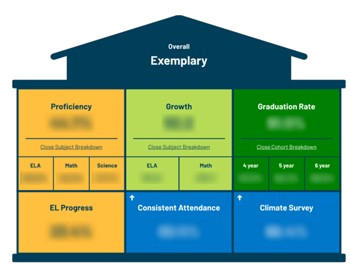


Profile of Performance

Core Indicators (Proficiency, Growth, Graduation Rate) 

Core Indicators recognize school strengths on critical student outcomes

---------------------------------------------------------------------------------------------

Elevating Indicators (EL Progress, Consistent Attendance, Climate Survey)
Strong performace on elevating indicators can raise a school's designation, never lower it.​​

Upcoming Webinars

Content Editor ‭[6]‬

Learn and Explore

Illinois provides a range of tools and resources to help users understand Profiles of Performance and use them to support continuous improvement.

Resources are organized to help users start with the basics, go deeper into specific topics, and apply what they learn.

START HERE: UNDERSTANDING THE SYSTEM​​

Begin with these resources to get a clear, high-level understanding of how the system works:​

GOING DEEPER: MAKING SENSE OF A PROFILE OF PERFORMANCE

MEASURE BY MEASURE: UNDERSTANDING EACH PIECE OF THE PROFILE

These resources explain the measures included in a Profile of Performance:

USING PROFILES FOR IMPROVEMENT

Resources that support planning, reflection, and action:

PARTNER AND LEADER-FOCUSED LEARNING OPPORTUNITIES

Additional sessions offered in partnership with the Illinois Principal Association and the Illinois Association of School Administrators provide practical guidance for applying the system in local contexts:

  • Modeling your school’s data
  • Coaching leaders through the system
  • Accountability for new principals
  • Conference sessions and Q&A opportunities

View the Partner Sessions​​

What a Profile Measures

A Profile of Performance brings together a focused set of measures that reflect student outcomes, along with select, practical indicators that offer actionable insight schools can use to improve school conditions and support learning.

Core Academic Outcomes

  • Proficiency – What students know and can do
  • Growth – How much students improve over time
  • Graduation Rate – How many students successfully complete high school

Elevating Indicators

Select indicators that provide schools with actionable insight to improve culture, engagement, and outcomes:

  • Attendance – A signal of student engagement and access to learning
  • School Climate Survey Participation – Helps ensure schools have inclusive, representative feedback from students, families, and staff
  • English Learner Progress – Reflects how English learners are developing the language skills needed for success in school

Student Groups

Performance is reported for all students and for individual student groups to ensure schools are serving every student well.

Together, these measures provide a more complete view of school performance. Understanding how they work together is key to making sense of a Profile of Performance.

Making Sense of a Profile

A Profile of Performance is both a collection of individual measures and a broader view of how a school is serving its students. Each part tells you something important — and together, they help show where a school is strong and where it may focus next. A Profile of Performance is designed to be understood as a set of connected signals, not a single score.​

  1. UNDERSTANDING PERFORMANCE LEVELS

    Each measure in a profile, both core academic outcomes and elevating indicators, is assigned a performance level.

    • These levels are shown using both a name and a color, making it easier to quickly understand performance at a glance:

      • Exemplary - Highest levels of performance
      • Approaching Exemplary - Strong performance
      • Commendable - Typical or average performance
      • Developing - Below average performance
      • Comprehensive - Low performance
      • Automatic Comprehensive - Exceptionally low performance (lowest 3–5% in the state)
    • These levels help quickly identify strengths and highlight areas that may need attention.

  2. LOOKING AT INDIVIDUAL MEASURES
    • Each indicator can be considered on its own.

      Looking at individual measures helps answer questions like:

      • Where is the school performing strongly?
      • Where might students need more support?

    This step helps identify specific strengths to build on and areas to improve.

  3. DETERMINING CORE PERFORMANCE

    The core academic indicators (proficiency, growth, and graduation rate) form the foundation of the profile.

    • In general:

      • A school’s core performance reflects its strongest core indicator.
    • However, low performance also matters:
      • If any core indicator is Comprehensive (orange), the overall core performance is adjusted down one level.
      • If any core indicator is Automatic Comprehensive (red), the entire profile is Comprehensive, reflecting an urgent need for improvement.

    This ensures that strong performance in one area does not mask serious challenges in another.

  4. CONSIDERING ELEVATING INDICATORS
    • Elevating indicators (like attendance, climate survey participation, and English learner progress) provide additional insight into school conditions.

      • A school can only elevate one level.
      • Elevation happens when elevating indicators are stronger than core performance.
      • Schools with the highest performance (Exemplary) or urgent needs (Automatic Comprehensive) do not elevate.
    • How elevation works (simplified):
      • To reach higher levels (Exemplary or Approaching Exemplary), schools need multiple Exemplary elevating indicators.
      • To move into mid-levels (Commendable or Developing), schools may elevate with a combination of strong elevating indicators (Exemplary and Approaching Exemplary).

    These elevation requirements ensure strong performance in areas that support student success. Together, these measures help identify patterns, highlight priorities, and guide next steps.

  5. LOOKING AT STUDENT GROUPS

    A Profile of Performance also looks at how distinct groups of students are performing.

    • This helps answer:

      • Are all students experiencing success?
      • Are there gaps between groups?
    • Important:
      • Some performance variation is expected.
      • However, if any student group has Comprehensive performance, the overall school performance cannot be higher than Commendable.

    This ensures that improvement efforts focus on all students, not just overall averages.

  6. A STARTING POINT FOR IMPROVEMENT

    Profiles are designed to support a strengths-based approach to improvement.

    • In general, schools aim to:

      • Build on their strongest areas
      • Improve lower-performing indicators
      • Reduce gaps between student groups
      • Support growth across all measures

    There is no single “right” way to improve. The best approach depends on each school’s context — but the profile helps identify where to start. The Statewide Framework for Success provides a shared process to support this work.


Using Profiles for Improvement

Profiles of Performance are designed to do more than describe performance — they help schools take the next step.

Illinois supports this work through the Statewide Framework for Success, which provides a shared approach to continuous school improvement.

  1. THE CONTINUOUS IMPROVEMENT PROCESS
    • School improvement is an ongoing cycle of inquiry: a process schools use to understand performance and take action. This cycle includes three connected phases:

      • Identify and Plan
        Understand strengths and areas for growth and set priorities
      • Implement and Monitor
        Put strategies into action and track progress
      • Examine and Reflect
        Review results, learn from what is working, and adjust
    • THIS CYCLE REPEATS OVER TIME, SUPPORTING CONTINUOUS LEARNING AND IMPROVEMENT.

  2. THE LEVERS THAT DRIVE IMPROVEMENT
    • Improvement efforts focus on key areas that have the greatest impact on student outcomes:

      • Governance
        Local boards of education help guide improvement by setting vision and priorities and aligning resources to support student success.
      • Leadership
        Leaders build collective capacity, foster collaboration, and ensure improvement efforts are implemented effectively.
      • Instruction
        Instruction directly impacts student learning through evidence-based, data-informed teaching practices that respond to student needs.

    These levers help schools turn plans into meaningful changes in teaching and learning.

  3. THE CONDITIONS THAT SUPPORT SUCCESS
    • Strong outcomes are supported by the conditions within a school. In the Statewide Framework for Success, these are described as three key domains: Culture, Systems, and Learning.

      • Culture
        Culture reflects a school’s efforts to create a student-centered environment where adults build positive, unconditional relationships with students, families, and staff, and ensure equitable access to inclusive, engaging, and culturally responsive learning opportunities.
      • Systems
        A systems approach recognizes the complexity of a school or district and how interconnected parts work together. Effective systems align structures, processes, and resources to keep student success at the center of all improvement efforts.
      • Learning
        Learning reflects a school’s efforts to create a data-driven environment grounded in evidence-based, inclusive, and culturally responsive practices. This supports continuous growth and ongoing reflection and adaptation.

Communication Tools

Resources to support clear communication with families, staff, and communities:

  • Family-facing one-pagers
  • Slide decks and presentations
  • Messaging and communication toolkits​

Data, Metrics, and Technical Details

For users who want detailed information about how measures are calculated and reported:

BUSINESS RULES

Business rules for the 2026 Profiles of Performance coming in July.

DATA and Metrics

Data for the 2026 Profiles of Performance coming in October.

2026 5Essentials Climate Survey​

The 2025–26 5Essentials Survey administration window is scheduled for February 3 through March 13​​, 2026, for all districts and schools except Chicago Public Schools (CPS) District 299. The CPS survey window is expected to open one week later, on February 10, 2026.

Participation and Rostering Requirements:

  • Eligible Schools: All public school districts and schools, including those with RCDTS codes beginning with 3 (e.g., 3XXX), are automatically rostered unless they have been approved for an alternate survey. List of SY26 rostered schoolsPDF Document.
  • Administrator rosters are generated from the Administrator of Record identified via the Entity Profile System (EPS).
  • Teacher rosters are generated using data from the Employment Information System (EIS). For teachers with multiple school assignments, their "Primary Working Location" in EIS will determine the school to which they are rostered. Valid teacher and staff emails are required for participation.
  • Student Rosters: Student rosters for grades 4 through 12 are generated from enrollments in the Student Information System (SIS). Student exclusions are limited to those correctly coded in I-Star with an IEP or those with an English Learner (EL) record (other than Spanish) in SIS.

REPORTING TIMELINES AND BEST PRACTICES

  •  Technical Advisory Committee
    The ISBE Accountability TAC brings together experts and leaders with broad experience developing, implementing, and/or validating statewide school accountability systems. The central purpose of the TAC is to provide advice and recommendations to ISBE to inform the design, implementation, and evaluation of Illinois’ ESSA accountability system.
  •  IL Balanced Accountability Measure Committee
    Illinois School Code {105 ILCS 5/2-3/25a(b-5)} ​created the Balanced Accountability Measure Committee within the State Board of Education. The purpose of the Committee is to develop recognition standards for student performance and school improvement for all school districts and their individual schools. The standards developed will be an outcome-based, balanced accountability measure.
  • What Does It Mean to Check Your Report Card Data?
    Build a strong foundation for understanding your data. This session reviews key ISBE systems, how data flows across them, and best practices for checking accuracy before using it for planning or accountability.
    Register for the “What Does it Mean to Check Your Report Card Data” session(s)Go To Meeting Link that works for your schedule by selecting the desired date on the registration form. A separate registration is required for each session.
    • Event Date and Time:
      • May 18, 1:30-3:30 p.m.
      • May 27, 12-2 p.m.
      • Jun 3, 9-11 a.m
      • Jun 22, 1-3 p.m.
      • Jul 9, 12-2 p.m.

This page has been archived. The content on this page may no longer be in effect.

Contact Information